

I have written numerous times in this blog about posture and the Alexander Technique. If you were to ask me now, “What is posture?” I would reply that posture does not exist. This seems absurd until one realizes that the word itself is an obstacle, a trap. It’s a trap because, as kids, we hated adults telling us our posture was “bad” and to sit up straight. The nagging only inflamed our resistance, and this resistance made sense since “good posture” felt tense, rigid and uncomfortable. Above all, the shape we adopted to be “good” was unsustainable, and soon enough we were slumping again.
The spiel many adults repeat in their minds is as follows: “Mom always nagged me about my poor posture and I hated that. Deep down, I know she was right, but when I try to ‘sit up straight’ it feels like hard work. Well, it isn’t hard really, but so awkward! I’d like to do better but don’t know how to go about it. Since I’ve always muddled through I’ll just keep muddling. Ouch!”
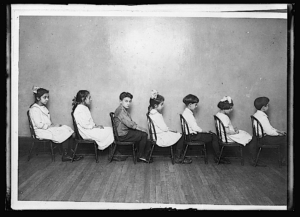
“Posture” class in NYC, 1921 via Library of Congress
How to exit the posture shame feedback loop
With all of these negative associations and misconceptions, it’s no surprise that adults dislike engaging with “posture.” So, how are we to help ourselves? How do we refine the way we sit, stand and walk without getting bogged down in our own baggage and shame? Websites replete with simplistic, one-size-fits-all explanations won’t do the trick.
First, we must blow up the word “posture” once and for all. Posture does not exist! Instead, let’s connect to the basic human needs posture implies and let’s try fulfilling those needs rather than getting hung up on a word. Instead of weeping about our prior posture traumas, let’s focus on these essentials for all humans:
- support
- balance
- integration
- comfort
Next, we can think about these needs in relation to aspects of the Alexander Technique:
- Dropping harmful habits and making fresh, beneficial choices
- Paying attention to the quality of our movements, especially their energy efficiency
- Noticing that in movement, our thinking is at least as important as our muscles
- Remembering that “posture” is not a shape… it is a dynamic process that we can refine using our awareness and understanding, all in support of our well being
How the Alexander Technique can help us
When we drop antiquated notions of “good posture” and abandon “sitting up straight,” we can see the true goal clearly. Our goal is to develop a skill that enables us to care for ourselves on a basic level while pursuing our ordinary activities. The Alexander Technique offers us a way to cultivate that skill. It consists of three things that happen simultaneously:
- Carefully examining our habitual movements;
- Learning why some of our habits are unhelpful and can be dropped; and
- Exploring new ways of thinking and moving that provide us with better support, improved balance, enhanced integration and greater comfort.
This is what’s on offer with the study of the Alexander Technique. Consider scheduling a free phone consultation to discuss how the AT can meet your needs, or dive right in and take a lesson. Thanks for reading!
Leave A Comment